In my native Finland, Valentine’s Day is officially Friendship Day. A beautiful idea. Yet research suggests many of us feel lonelier than ever, particularly in midlife. I hear this often in my client conversations, perhaps slightly more from midlife men who admit that their social world has narrowed.
It is not surprising.
Midlife can be a logistical and emotional squeeze. We are juggling children, aging parents, careers, relocations, health changes and increasingly remote or hybrid work. Many of us are also constantly distracted by our smartphones. The natural ecosystems that once made friendship easy, school, university, early career cohorts, shared houses, simply fade away. What remains requires intention, time and energy. And sometimes courage.
There is also a psychological layer. In a recent piece in The Guardian, journalist Emma Beddington explores how friendship can boost health outcomes. Neuroscientist Ben Rein explains that humans are surprisingly poor at predicting how social interactions will feel. We tend to assume we will enjoy them less than we actually do, underrate our own social skills and underestimate how much others like us. Psychologists call this the “liking gap”.
Rein suggests this caution has deep evolutionary roots. In early human groups, belonging was vital and exclusion costly. Social missteps could have serious consequences. So we evolved to tread carefully. A certain degree of social anxiety is built in.
The problem is that this ancient wiring operates in a very different modern context. A coffee invitation or networking event does not carry the same existential risk as being cast out of a tribe. Yet our brains can still interpret it as socially dangerous. So we hesitate, postpone, or assume others are too busy or not that interested.
And yet, connection matters profoundly. The Harvard Study of Adult Development, one of the longest running longitudinal studies on adult life, has consistently shown that people who report warmer, deeper relationships in midlife are healthier, happier and live longer. Close relationships are not a soft luxury. They are a predictor of wellbeing and even longevity.
From a coaching perspective, I often see that the cost of neglecting friendship shows up indirectly. It appears as low-grade loneliness, emotional fatigue, or the sense that one must carry everything alone. High achievers can be particularly vulnerable here. They are competent, busy and often surrounded by people professionally, yet lack spaces where they can be fully themselves.
Personally, I have found midlife self-awareness to be an unexpected advantage. With more clarity about who I am, I find it easier to identify “my crowd” and connect more quickly and authentically, including at dreaded networking events. Less masking. Less people-pleasing. Less pressure to be liked by everyone.
These friendships have helped me stay sane through corporate life, motherhood, redundancy, personal loss, pivoting and starting a business. They have been stabilisers, mirrors and reality checks. They have also been a source of laughter when life felt heavy.
Perhaps midlife friendship is not about having more friends. Perhaps it is about braving the liking gap and choosing depth over breadth. It may require more intentionality than it did at twenty. But it may also be richer, because we know ourselves better.
Happy Friendship Day.
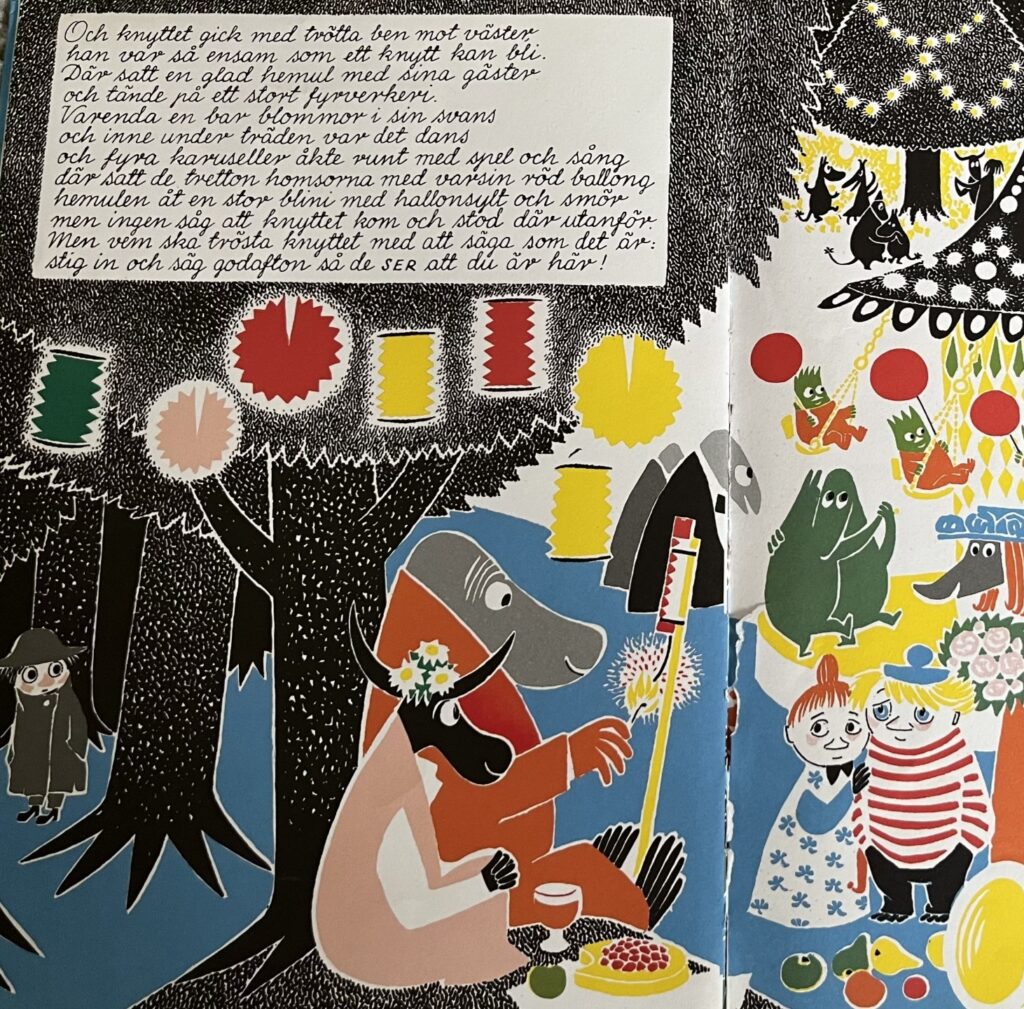
The picture above is from my well worn copy of Vem ska trösta knyttet? by Tove Jansson, a story that in many ways is about daring to reach out despite fear. And Why Brains Need Friends by Ben Rein is firmly on my reading list.